

Close
CART (0)

The Short Answer
A motorcycle jacket worth buying comes down to four things: full-grain or top-grain leather (not "genuine leather" - that label actually marks a lower grade), a fit checked in riding position rather than standing in a mirror, a build matched to your climate, and honest expectations - a heritage leather jacket protects against wind, weather, and time; dedicated armored riding gear protects against pavement. Know which one you're buying and why.
Updated July 2026
The motorcycle jacket has one of the best origin stories in menswear. In 1913, two brothers - Irving and Jack Schott - started making raincoats in a basement factory on Manhattan's Lower East Side. Years later, Irving built something new: a leather coat designed for warmth, protection, and comfort on a motorcycle. He named it after his favorite cigar - the Schott Perfecto.
It was the first true leather motorcycle jacket, and the first jacket to close with a zipper instead of buttons. The belted waist locked it down against the wind. The asymmetrical front moved the seam off the center of the chest, so it sat comfortably when a rider hunched forward over the bars - and doubled the leather across the front while it was at it. Riders didn't just wear it. They adopted it. A century later, the silhouette still means the same thing it meant then: motion, independence, and a little bit of trouble.
Here's what a hundred-plus years of that tradition teaches you about buying one today.
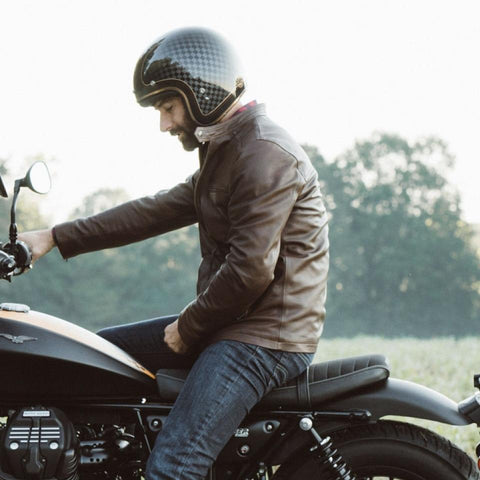
This is where most buying guides get it wrong, including plenty written by people selling jackets. "Genuine leather" sounds like a mark of quality. It isn't. It's an actual grade of leather - and a low one, cut from what's left after the better layers are split away. A jacket can be 100% "genuine leather" and still crack, stiffen, and quit on you in a few seasons.
What you want is full-grain (the top layer of the hide, all the natural grain intact - the strongest fibers there are) or top-grain (the second-highest grade, lightly sanded, thinner and more uniform). Full-grain costs more because it costs more to make and it's harder to work. In exchange, it doesn't wear out - it wears in, molding to you and building a patina that synthetic and low-grade leather can't fake.
For riding specifically, leather earned its place the hard way: hide is dramatically more abrasion-resistant than most fabrics, which is why it's protected riders since before anyone thought to test these things in a lab. Textile, mesh, and kevlar-hybrid jackets have their place too - they're lighter and vent better - but they're a different tool for a different job.
An Honest Word About Protection
We build heritage leather jackets, so let us say this plainly: a fashion or heritage leather jacket is not certified protective riding gear. If you ride hard, ride fast, or ride daily, dedicated motorcycle jackets with CE-rated armor - reinforced impact zones, hard sliders, pre-curved sleeves - exist for a reason, and quality leather is often what those are built from too.
A well-made full-grain jacket gives you real abrasion resistance, wind protection, and warmth, and it looks better at year ten than year one. Armored gear gives you impact protection. Some riders own both and choose by the ride. What matters is knowing which one is on your back - a guide that blurs that line isn't doing you any favors.
A motorcycle jacket has to fit in riding position. Standing in front of a mirror tells you almost nothing.
Reach forward like you're on the bars. The sleeves shouldn't ride up past your wrists. The back shouldn't lift and leave a gap at your belt line. The shoulders should move with you, not fight you. Too bulky and it flaps and fatigues you at speed; too tight and it restricts exactly when you need to move.
Your riding position matters too. A cruiser rider sits upright; a sport rider folds forward - the same jacket fits those two bodies differently. Whatever you ride, test the jacket the way you'll actually wear it. (Our full leather jacket sizing guide covers this in detail, including why most men should consider sizing up.)
Leather jacket pricing isn't mysterious. It tracks two things: the grade of the hide and the quality of the construction. Full-grain leather, quality hardware, and real stitching cost real money to produce - and that's reflected on the tag. A suspiciously cheap "leather" jacket got cheap somewhere: the hide, the zippers, or the labor.
The math that matters is cost per year. A cheap jacket that quits in three seasons costs more than a quality one you wear for twenty.
We've said it before and it holds here: buy something you intend to wear for life.
Cold or Variable Climates
Leather is the answer. It's a genuinely excellent insulator, it blocks wind outright, and it shrugs off weather that soaks fabric. Mountain mornings, shoulder-season rides, year-round commuting in the north - this is leather country.
Hot Climates
A heavy leather jacket in August traffic is a commitment. Textile and mesh options vent far better, and plenty of warm-weather riders keep one for the worst months. Riding city-to-mountains? Carry for the mountains. Mountains-to-beach? Dress for the descent.
The reason the motorcycle jacket never dies as a style piece: it works as hard off the bike as on it. If your taste runs rugged, pair it with leather gloves, a rugged belt, and a tough pair of boots - dark jeans with some wear in them, a fitted knit underneath, done. Cleaner and more modern works too: keep the lines slim, the colors dark, and let the jacket be the loudest thing you're wearing. A good watch never hurts.
The one rule: the jacket should look like yours. Leather that's been worn, ridden, and rained on looks better than leather that hasn't - that's the whole point of buying quality.
Leather is skin. Treat it like yours and it outlives trends; neglect it and it goes stiff, discolored, and brittle - no matter what you paid.
After a ride, wipe down the dust and road grime. If you got caught in the rain, let it dry naturally - never against a heater - and condition it once it's dry. A few minutes of care per month is the difference between a jacket that lasts five years and one that lasts fifty. Here's our full guide on how to care for leather.
Everything above is exactly the standard we build to. If you're looking for the jackets that came out of it, here's the moto and rider-inspired lineup - all full-grain, all designed to be worn for decades, not seasons.
Our signature moto. 100% full-grain lambskin that's soft from day one, with a quilted lining, four zippered exterior pockets, zippered cuffs, and antique-brass YKK hardware. It runs slim and tailored - when in doubt, size up.
A tribute to Europe's golden age of motorcycling - where speed met elegance. Full-grain leather with a distressed finish, light understated padding for a refined profile, antique-brass YKK hardware, and tailored zippered cuffs. Fair warning from the reviews: this one starts tougher than our lambskin pieces and breaks in with wear - the way full-grain is supposed to.
Not a moto jacket by lineage - this one descends from the aviators, not the riders - but it's earned a place in the same closet. Full-grain lambskin with a broken-in feel from day one, ribbed cuffs and waist, and a detachable sherpa collar that gives you two jackets in one. Unlike the Thompson, the Maverick runs standard - if you're between sizes, size down.
Browse the full lineup in our motorcycle leather jackets collection and bomber jackets collection.
The motorcycle jacket earned its icon status by doing a job: protecting riders and looking better every year it did it. Buy full-grain or top-grain, fit it in riding position, be honest about what protection you need, match it to your climate, and take care of it after. Do that, and you're not buying a jacket for next season - you're buying the one your kid argues over someday.
For a rundown of every leather jacket style and which fits you, read Types of Leather Jackets: Which Style Are You? And if you're getting on a bike soon, these motorcycle safety tips are worth ten minutes of your time.
Is leather or textile better for a motorcycle jacket?
Leather offers superior abrasion resistance, wind protection, and longevity - and it improves with age. Textile and mesh are lighter and vent better, which matters in hot climates. Many riders own both and choose by the ride. For impact protection specifically, look for dedicated gear with CE-rated armor regardless of material.
Is "genuine leather" good for a motorcycle jacket?
No - and this surprises people. "Genuine leather" is a specific grade, and a low one, made from the layers left after the top of the hide is split away for better grades. For a jacket that lasts and protects, look for full-grain (best) or top-grain (second best) leather.
How should a motorcycle jacket fit?
Snug but not restrictive, and checked in riding position - arms reached forward as if on the bars. Sleeves shouldn't pull past your wrists, the back shouldn't ride up, and the shoulders should move freely. Fit standing still tells you very little.
Are heritage leather jackets safe for riding?
A quality full-grain leather jacket provides real abrasion resistance and weather protection, but it is not certified protective riding gear. For serious or daily riding, dedicated motorcycle jackets with CE-rated armor provide impact protection a fashion or heritage jacket doesn't. Know which one you're wearing and choose for how you ride.
How do I care for a leather motorcycle jacket?
Wipe off dirt and road grime after rides, let a wet jacket dry naturally away from heat, and condition it regularly. Cared for, full-grain leather lasts decades and looks better with age.


